|
CLARK
MASTS |
| Page 8 of 18 - Clark Masts, over 70 Years Old in 2025 - Surveyor Field Mounted Mast Kit |
|
In the early 1970's Clark Masts published their first catalogue in 16 years.
Alec Clark, the company's founder had been designing and building portable
air-operated telescopic masts since 1957. During this time Alec Clark's unique
lightweight portable masts had found their way into applications throughout the
world with government Departments Of Defence, Police Departments, Fire
Departments and Emergency Services. Commercial and industrial applications
included for Radio Field Strength Surveying, TV Field Strength Surveying and
portable radio communications. Alec Clark's company, Clark Masts Limited, performed practically ever manufacturing operation itself in-house. Fabrication, casting, precision machining, canvas sewing, plastic and rubber mouldings, anodising and plating, painting, printing, publishing and even the manufacture of packing cases were all in-house operations. Australian users first saw these unique portable masts in the early 1960's courtesy of a antenna manufacturing company called Belling-Lee and the foresight of a gentleman working for them at the time, Frank Welsh. Frank went on, with others, to form his own company, Scalar Industries, in the late 1960's and brought the Clark Masts agency with him. Following Frank Welsh's retirement from Scalar in the mid 1980's GFS Electronics took on the Australian distributorship and continued to market Clark Masts in the Australia Asia-Pacific region until the company was closed in 2011. In 2012 a new company, started by Greg Whiter, who was previously Managing Director of GFS Electronics took over the Australian distributorship of Clark Masts. That new company is Portable Masts Australia Pty Ltd. Illustrated in this web page, for historical purposes, is the Surveyor Field Mounted Mast page from Clark Masts early 1970's catalogue. The Surveyor Field Mounted mast is still available today and can be seen here. |
|
|
|
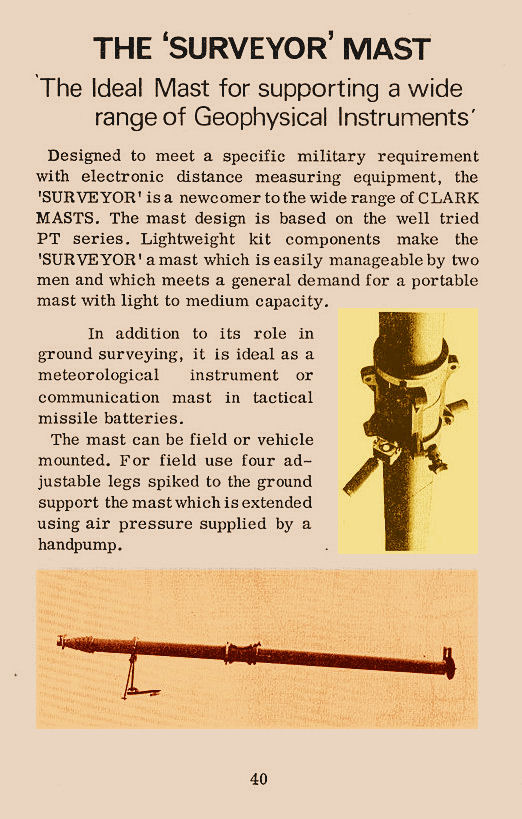
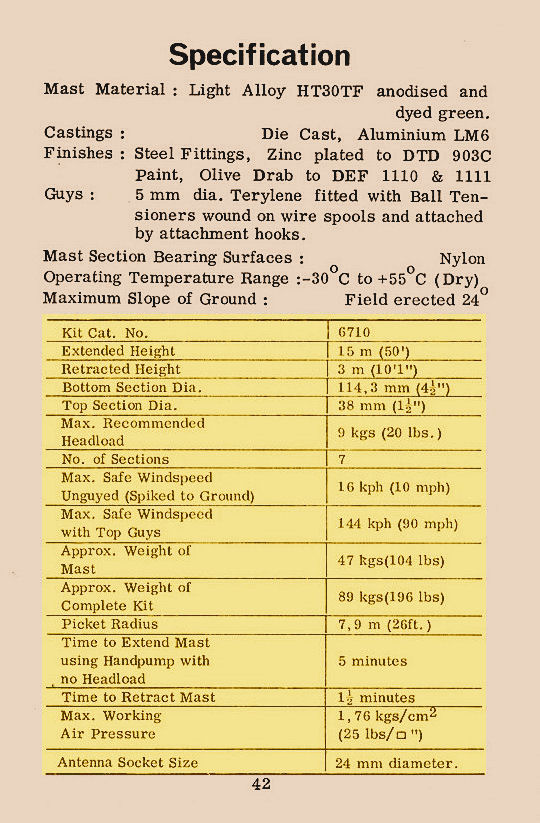
The Clark Masts Surveyor Field Mounted mast of the late 1960's - early 1970's was designed to take light to medium duty loads, being a unique mast based on their PT mast series. The Surveyor was a designed to lift geophysical equipment, the likes of which is used in the surveying field. Like all other PT Series masts the Surveyor's mast sections were keyed to prevent inter-section rotation, making it suitable for use with directional headloads. The Surveyor's extended height was 15 metres using 7 sections which provided a retracted height of 3 metres. Like all PT Series masts, the Surveyor's base tube diameter was 114.3 mm (4.5") and the mast had a headload capability of 9 Kg. A Handpump was supplied for mast extension/retraction. |
|
|
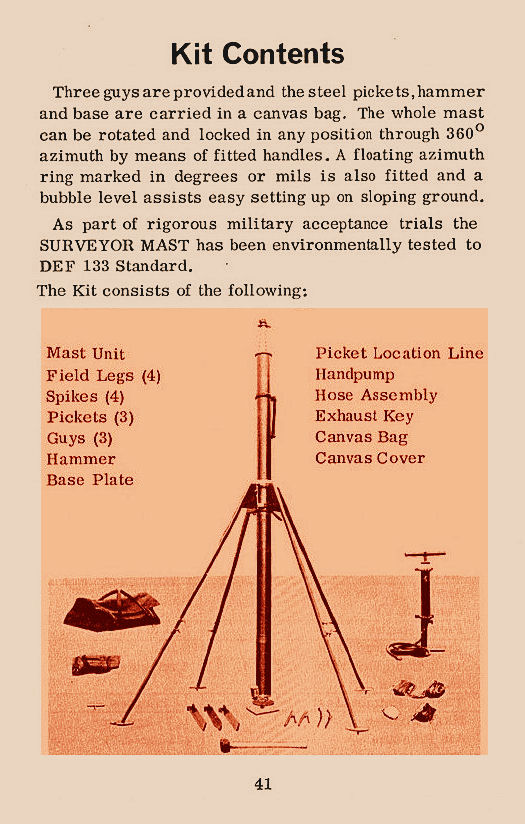
The Clark Masts Surveyor Field Mast Kit was supplied with all the components necessary for a portable field mounted mast. These included an attached folding leg Tripod, Guy Assemblies, Guy Stakes, Guy Stake Hammer, Guy Stake Location Line, Base Plate, Base Plate Spikes, Handpump, Mast, Weather Cover and an Accessory Carrying Bag. The total weight of the Surveyor mast with it's attached legs was 47 Kg while the entire mast kit weight was 89 Kg. A deployed Surveyor mast had a wind speed rating, with 1000 square cm sail area on top into wind, of 16 km/hr un-guyed and 144 km/hr when guyed. The specified time taken to extend the mast with it's handpump was 5 minutes. |
|
|
