|
WHERE DID IT ALL START?
A CHRONOLOGICAL HISTORY OF THE DEVELOPMENT
OF RADIO
|
| Page 1 of 7 - In The Beginning - Static Electricity |
No historical article on radio
would be considered
complete if it did not include some of the events leading up to the human
race’s first deliberate transmission and reception of radio waves. Hence since
radio is based on electricity our
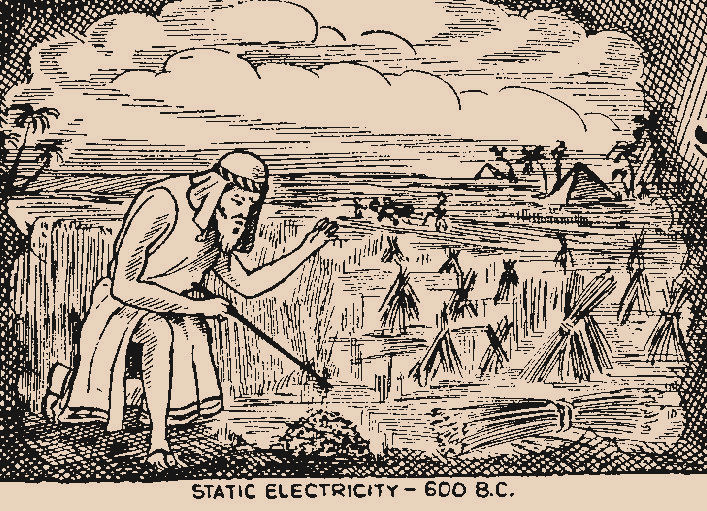
journey must begin in ancient times with discovery of the peculiar spark
producing properties of amber when
this material was rubbed on a piece of cloth or fur. Similarly, knowledge of
the magnetic attraction in loadstone,
which dates back to the days of the ancients, was an epochal event; inasmuch as
both these “accidents” were responsible for the later discovery and refinement
of electrical laws and principles, which served as the foundations on which
“radio” was eventually built. While no exact dates are available, historic
references to the phenomena surrounding amber and loadstone date it as far back
as 600 BC. In that era it is said Thales discovered the mysterious sparks
(today known as static electricity) which resulted from rubbing the mineral
amber. Since the Greek word for amber is “electrum” it served as the basis for
a new word - electricity when the experiment was repeated many centuries later
so that more could be discovered about its cause and effect.
During the long interim, strange and fantastic
superstitions were conceived concerning static electricity and magnetism. The
philosophers of the early days theorised quite a bit, but did very little
experimenting; and what was known was handed down from generation to generation
with elaboration and no attempt of justification by, at least, trial-and-error
experiments. Consequently, we find such fallacies, based more on hearsay, as
“garlic odour destroys the magnetic properties of a loadstone or compass.” This
myth lasted through the early centuries right up to 1544, when the famous
treatise on Physics by Philip Melanchthon included mention of it. After that
numerous controversies sprang up, pro and con, until 1646 when it received its
death blow from Sir Thomas Browne. This astute physician-scientist refused to
take anybody’s word for it, and actually performed experiments with magnetised
iron and “garlik juice” – thus definitely disproving the centuries-old superstition. Similarly numerous theories were created concerning
amber and diamonds; among them the most notable being that iron rubbed with a
diamond became a magnet, and that diamonds when rubbed would attract pieces of
paper and particles of dust. Another English scientist, Dr. William Gilbert,
outraged at what he termed “chattering of barbers”, undertook to disprove these
theories by actual experiment. This led Gilbert to compile a huge list of materials
which could be “electrified”, including such items as “true and imitation
jewels, sulphur, sealing wax, rock salt, alum, resin”, etc. It was this
gentleman who gave the term “electric” to the effect, and later on, in 1675,
Robert Boyle, in his “Mechanical Production of Electricity”, coined or derived
the word “electricity” from it. More important, however, is Gilbert’s invention
of the ‘electroscope”, which he probably used to test the various materials
listed in his lengthy compilation. Also, he too set a precedent by conducting
actual experiments before publishing scientific information, refusing to accept
hearsay as fact. With the beginning of electricity came a new era in
scientific research; from then on scientists resorted to trials and testing to
confirm their theories. The mysteries and superstitions of the ancients were
dispelled back into the darkness. Electricity was born and new fields were open
for conquest. Perhaps that is why Gilbert is referred to by some as the “Father
of Electricity”. In any case, since this period marks the inception of
scientific electricity, because of the gradual elimination of rumours,
guesswork and superstition, the chronology begins with the date 1600. Without
question however, some scientific work of importance in this field was reported
earlier but will not be covered here.
1646 SIR THOMAS BROWNE, English physician and author.
Performed many
1729 STEPHEN GRAY, Englishman. By experimenting with charged
bodies, Gray discovered the effect and the differences of what we now know as
conductors and insulators, as regards conveying or transmitting charged
impulses. Also about this time, DUFAY, a Frenchman, conducted similar
experiments but along more elaborate lines.
|
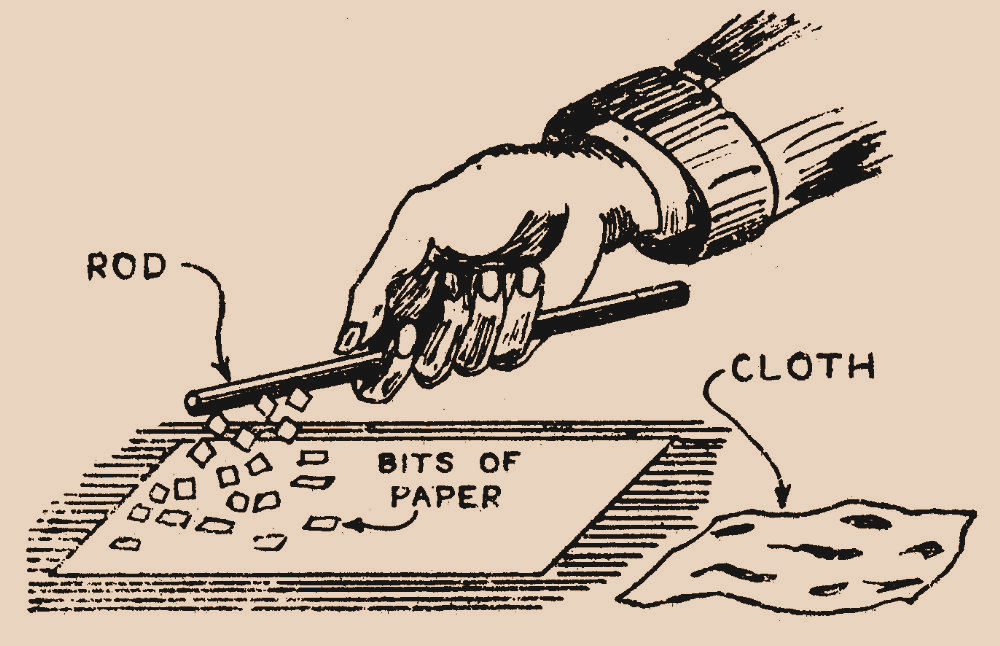 To his discomfiture, he found that rubbing
diamond did cause them to attract
pieces
To his discomfiture, he found that rubbing
diamond did cause them to attract
pieces 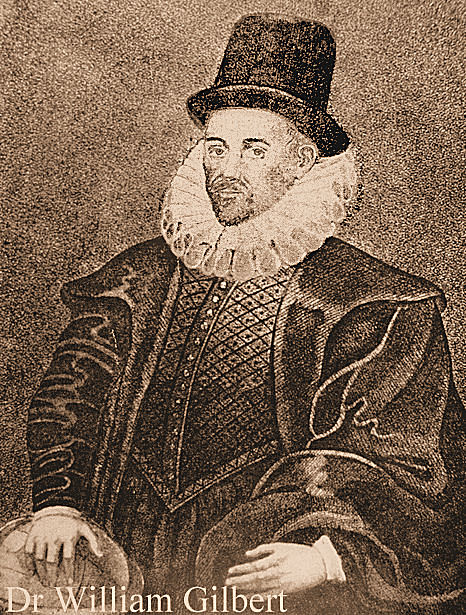
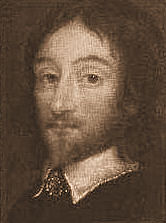 experiments with the loadstone and magnetism, refuting many idle
superstitions by actual trial. Tried to make the first “wireless” by employing
two compasses with the alphabet written about them (although credit for the
idea must be given to a predecessor, one John Baptista Porta). He imagined that
if the two needles were magnetised together, then separated, the turning of one
to indicate some letter of the alphabet would cause the indicator on the second
dial to move to a similar position; thus envisioning a means of communication
without any intervening medium. The second compass needle, however, did not
budge from its North-pointing position, remaining he said “like the Pillars of
Hercules”. Nevertheless, the thought of communicating between persons over a
distance, previously more or less a figment of the imagination that inspired
very few people in the centuries before, now became an intriguing thought in
the minds of many scientists of that time.
experiments with the loadstone and magnetism, refuting many idle
superstitions by actual trial. Tried to make the first “wireless” by employing
two compasses with the alphabet written about them (although credit for the
idea must be given to a predecessor, one John Baptista Porta). He imagined that
if the two needles were magnetised together, then separated, the turning of one
to indicate some letter of the alphabet would cause the indicator on the second
dial to move to a similar position; thus envisioning a means of communication
without any intervening medium. The second compass needle, however, did not
budge from its North-pointing position, remaining he said “like the Pillars of
Hercules”. Nevertheless, the thought of communicating between persons over a
distance, previously more or less a figment of the imagination that inspired
very few people in the centuries before, now became an intriguing thought in
the minds of many scientists of that time.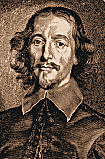 1672
1672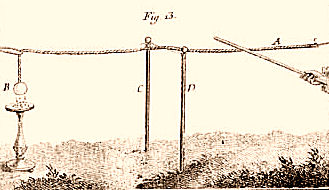 He, evidently, was familiar with
Gray’s accomplishments because his work seemed to be in the line of proving or
disproving Gray’s discoveries. In the course of his experiments he found that
metal wires or wet objects were the best conductors, though the most difficult
to electrify, while those easiest to electrify were the best insulators of his
charged impulses. In fact he built a line, a quarter-mile long (400 metres),
which consisted of wet thread held up by glass tubes and determined that it was
an excellent means of conveying a charged impulse from one end to the other.
This was probably the first transmission or electric line and so was an
important discovery. About this time Dufay also laid down the basis of the
vacuum tube (although he didn’t know it at the time) when he discovered that if
one of two spheres was heated, a current carrying path was formed between them.
He, evidently, was familiar with
Gray’s accomplishments because his work seemed to be in the line of proving or
disproving Gray’s discoveries. In the course of his experiments he found that
metal wires or wet objects were the best conductors, though the most difficult
to electrify, while those easiest to electrify were the best insulators of his
charged impulses. In fact he built a line, a quarter-mile long (400 metres),
which consisted of wet thread held up by glass tubes and determined that it was
an excellent means of conveying a charged impulse from one end to the other.
This was probably the first transmission or electric line and so was an
important discovery. About this time Dufay also laid down the basis of the
vacuum tube (although he didn’t know it at the time) when he discovered that if
one of two spheres was heated, a current carrying path was formed between them.