|
1886
E.T.
FISK Australian Radio Pioneer. Ernest Fisk was born at
Sunbury-on-Thames, England, on 8th August 1886. At age 16 he attended
the Marconi Company's wireless training school at Liverpool, England.
Both there and at the Marconi Works and Laboratories at Chelmsford he
gained his early training
 in
wireless engineering and operating. His outstanding ability was soon
recognized by the company and, in 1909, he was sent on a special mission
to the Arctic ice fields. Then, in 1910, Marconi employed him to demonstrate
their wireless systems to the Newfoundland sealing fleet. New York was
his next stop, where the American Marconi Company had him erect and
operate a number of radio sites for them. This task was followed by his
assisting in the early development of a maritime wireless communications
system along the St. Lawrence shipping route. Such a diverse wireless
background served him well during his next deployment for the Marconi
Company, which was in
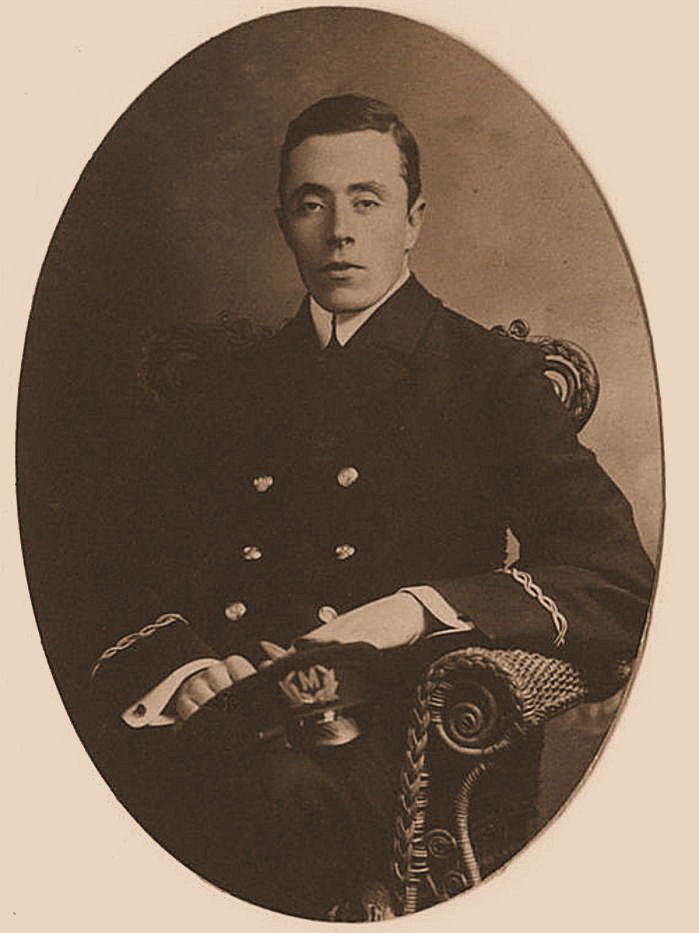
Australia . The photo at right shows Fisk in
1911. in
wireless engineering and operating. His outstanding ability was soon
recognized by the company and, in 1909, he was sent on a special mission
to the Arctic ice fields. Then, in 1910, Marconi employed him to demonstrate
their wireless systems to the Newfoundland sealing fleet. New York was
his next stop, where the American Marconi Company had him erect and
operate a number of radio sites for them. This task was followed by his
assisting in the early development of a maritime wireless communications
system along the St. Lawrence shipping route. Such a diverse wireless
background served him well during his next deployment for the Marconi
Company, which was in
Australia . The photo at right shows Fisk in
1911.
In 1904 the Marconi Company erected a
wireless station at Queenscliff, on the Victorian southern coast, along
with a complimentary station at Devonport on Tasmania's northern coast.
The purpose of these two stations was to demonstrate to the Australian
government and it's people the practicability of wireless communication
across Bass Strait between Australia's two land masses. However it
was not until 1910 that this new science of wireless, as a communication
medium, began to be taken seriously by Australia. In that same year
Ernest Fisk arrived in Australia as an employee of the Marconi Company.
Marconi was at this time in negotiations with
the Orient Steam Navigation Company with the ultimate aim of fitting all
their
 ships
for wireless. In order to demonstrate the advantages of the service that
this would provide Orient Steam Navigation Company, Ernest Fisk was
stationed, as a wireless operator-engineer, on their ship the "Otranto". Fisk
made two trips on that ship and amply proved to the Orient Steam Navigation
Company the value of Marconi's wireless equipment. At the same time he
established several world wireless records, including two-way communication
between the British Warship "Powerful", moored in Sydney harbor, and his location 200
miles to sea off Fremantle, Perth. In May 1911, following this successful
demonstration Ernest Fisk was appointed resident Australian engineer for the
Marconi Company. From a small office in Bond Street, Sydney, and in the name
of the Marconi Company, he set out to further develop wireless usage
throughout the Commonwealth of Australia and it's territories. The photo
above show Ernest Fisk in 1924. ships
for wireless. In order to demonstrate the advantages of the service that
this would provide Orient Steam Navigation Company, Ernest Fisk was
stationed, as a wireless operator-engineer, on their ship the "Otranto". Fisk
made two trips on that ship and amply proved to the Orient Steam Navigation
Company the value of Marconi's wireless equipment. At the same time he
established several world wireless records, including two-way communication
between the British Warship "Powerful", moored in Sydney harbor, and his location 200
miles to sea off Fremantle, Perth. In May 1911, following this successful
demonstration Ernest Fisk was appointed resident Australian engineer for the
Marconi Company. From a small office in Bond Street, Sydney, and in the name
of the Marconi Company, he set out to further develop wireless usage
throughout the Commonwealth of Australia and it's territories. The photo
above show Ernest Fisk in 1924.
During this early period in Australia, one of Ernest Fisk's roles
for Marconi had been to equip various Australian shipping companies with Marconi
wireless equipment and also, where possible, act as ship's wireless
operator. At this time Australia had no established wireless coastal
stations for communicating with ships at sea. In order to meet this need
Fisk arranged a roster system, having ships in port communicate with other incoming
and outgoing wireless equipped ships at sea. Under the roster, in-port ship's
wireless operators were encouraged to keep wireless watch, communicate
messages to other ships both at sea and in port, and deliver any messages to
the Post Office for further transmission and delivery if necessary. These
in-port ships thereby acted as temporary coast stations. It was a mammoth
task, however the difficulties faced by Fisk in achieving these goals merely
served to whet his appetite for the future work which lay ahead of him in
guiding Australia into the wireless age. Fisk's original Marconi appointment in
Australia was for a six month period only, however he so enjoyed the
challenges presented by his job that he requested Marconi Company to allow
him to stay on permanently.
In 1913, as a result of Australian Government
pressure, the Australian Wireless Company, which
represented Telefunken interests, was merged with the Australian branch of the Marconi Company to
become Amalgamated Wireless Australia Limited, AWA. At the age of 27 Ernest Fisk
was appointed General Manager and a member of the founding board of the new
AWA company. He remained AWA's General Manager until 1916, at which time he was appointed
Managing Director, a role he played until 1944. One of Fisk's early goals
for this new company was to manufacture wireless equipment in Australia
instead of importing it from overseas as had traditionally occurred. AWA
could readily achieve this due to their access to both the numerous Marconi and
Telefunken wireless patents. Under Fisk's guidance the new company also set about
developing maritime communications in the region as well as training operators in
the Sydney/Melbourne Marconi Schools of Wireless. By 1927 20 ships of the
Mercantile Marine had been equipped with wireless, manned by 250 operators,
largely as a result of the Fisk/AWA initiative. The year 1916 also saw Ernst
Fisk marry his Australian bride, Florence Chudleigh, at St John's church in
Gordon, NSW.
Amalgamated Wireless Australia Limited, AWA. At the age of 27 Ernest Fisk
was appointed General Manager and a member of the founding board of the new
AWA company. He remained AWA's General Manager until 1916, at which time he was appointed
Managing Director, a role he played until 1944. One of Fisk's early goals
for this new company was to manufacture wireless equipment in Australia
instead of importing it from overseas as had traditionally occurred. AWA
could readily achieve this due to their access to both the numerous Marconi and
Telefunken wireless patents. Under Fisk's guidance the new company also set about
developing maritime communications in the region as well as training operators in
the Sydney/Melbourne Marconi Schools of Wireless. By 1927 20 ships of the
Mercantile Marine had been equipped with wireless, manned by 250 operators,
largely as a result of the Fisk/AWA initiative. The year 1916 also saw Ernst
Fisk marry his Australian bride, Florence Chudleigh, at St John's church in
Gordon, NSW.
 World
War 1 presented Ernest Fisk with a severe testing ground. At it's outbreak
he volunteered for active service in the armed forces, however the
Australian Naval Board requested that he continue his wireless work in
Australia with AWA. To this end he trained and supplied wireless operators
and engineers for both the land, sea and transport forces, as well as the merchant
navy. He established wireless detection stations stations at various points
around the Australian coastline, and organised wireless based protection measures for
Australian ships at sea. World
War 1 presented Ernest Fisk with a severe testing ground. At it's outbreak
he volunteered for active service in the armed forces, however the
Australian Naval Board requested that he continue his wireless work in
Australia with AWA. To this end he trained and supplied wireless operators
and engineers for both the land, sea and transport forces, as well as the merchant
navy. He established wireless detection stations stations at various points
around the Australian coastline, and organised wireless based protection measures for
Australian ships at sea.
The photo at left shows AWA's York Street, Sydney, headquarters.
In 1916 E. T. Fisk took a visit to England on
behalf of Amalgamated Wireless Australia in order to discuss with his colleagues at
the Marconi Company a matter that was of great interest to both parties. The Australian
coastal stations had been picking up signals from Germany's major wireless
transmitter at Nauen. There had been no previous experience of wireless
reception over such a great distance. Fisk believed that direct wireless
communication between Britain and Australia was possible. He arranged for
test transmissions to begin soon after his visit, using the Marconi high power
longwave station at Carnarvon, Wales. These efforts were rewarded when, on 22nd
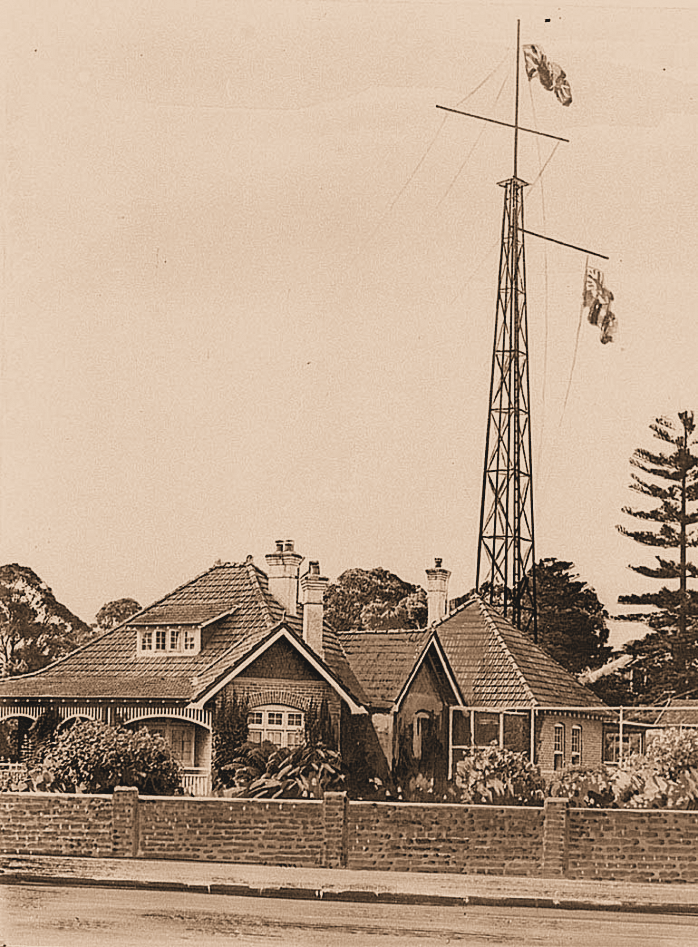
September 1918, he received the first wireless message from Carnarvon at his
own experimental amateur station in his home at Wahroonga, NSW, a photo of
which is shown below. This success led him to advocate a direct wireless
service between Britain and Australia, the Marconi Company also backing him in
this proposal. Marconi claimed that they could carry all classes of messages
at a price 33.3% below normal cable costs. The Australian Government liked
the proposal, however the Post Offices of both England and Australia
unfortunately opposed it. This initial opposition ultimately led to the
formulation of a scheme called
 the "Norman Plan" by which messages where to
be relayed via longwave stations located 2000 miles apart between England
and Australia. The Australian
government, and Fisk, were not completely satisfied with such a solution, so when he
attended the 1921 Imperial Conference in London, the Australian Prime
Minister, W. M. (Billy) Hughes, took Ernest Fisk with him as an adviser. The
result being that Australia was released from participating in the Norman
Plan. the "Norman Plan" by which messages where to
be relayed via longwave stations located 2000 miles apart between England
and Australia. The Australian
government, and Fisk, were not completely satisfied with such a solution, so when he
attended the 1921 Imperial Conference in London, the Australian Prime
Minister, W. M. (Billy) Hughes, took Ernest Fisk with him as an adviser. The
result being that Australia was released from participating in the Norman
Plan.
In 1923 an Australian Parliamentary Select
Committee was convened,
resulting
in the adoption of an agreement proposed by Fisk, which would see
the implementation of a direct shortwave wireless service from Australia to England. Rates
for this service would be 33.3% below existing cable charges. The agreement
also saw AWA's capital increased to one million pounds and the Australian
Government become it's major shareholder. Simultaneously the Australian
Government took over AWA's coastal wireless stations, which, up
until then, had been running
at a considerable loss. This agreement was signed and adopted in March,
1922.
Later that year E. T. Fisk visited South Africa
and persuaded the Prime Minister of that country to also adopt a direct
shortwave Beam Wireless service to England. Fisk traveled on from there to Great Britain, successfully advocating a change in the British Government's
policy which subsequently permitted Australian and British wireless companies to establish direct shortwave beam wireless services to England.
In 1924 Ernest Fisk conducted wireless
experiments from Vaucluse, NSW, in conjunction with Marconi's Poldhu,
Cornwall, shortwave transmitter. These experiments demonstrated the
feasibility of direct shortwave wireless communication between Great Britain
and Australia using relatively low power shortwave equipment. Wireless t elephonic
communication was also established in May of 1924, and the first
transmission of shortwave wireless telegraphic signals as a public service took place in November,
1924.
Having now been proven, shortwave Beam Wireless transmitting and
receiving stations for Empire communications were constructed 40 miles
northwest of Melbourne at Balan (transmitting site) and 20 miles northwest
of Melbourne at Rockbank (receiving site). These become operational in
April,1927. The
transmitting station at Balan was subsequently name "Fiskville" in honor of
Ernest Fisk. 1928 saw the establishment of a similar Beam Wireless service between
Australia and Canada. elephonic
communication was also established in May of 1924, and the first
transmission of shortwave wireless telegraphic signals as a public service took place in November,
1924.
Having now been proven, shortwave Beam Wireless transmitting and
receiving stations for Empire communications were constructed 40 miles
northwest of Melbourne at Balan (transmitting site) and 20 miles northwest
of Melbourne at Rockbank (receiving site). These become operational in
April,1927. The
transmitting station at Balan was subsequently name "Fiskville" in honor of
Ernest Fisk. 1928 saw the establishment of a similar Beam Wireless service between
Australia and Canada.
The photo at left shows E. T. Fisk with
the then Australian Prime Minister, W. A. (Billy) Hughes.
Fisk continued to organize experiments in long
distance voice (telephonic) wireless transmissions, including the first
inter-Empire broadcast from Sydney to London in September 1927.
In April 1930 Ernest Fisk instigated the Australian end of the first
inter-Empire direct wireless telephone service. He also pioneered the first
world-wide shortwave broadcasting service from Australia, the for runner for
what is now Radio Australia.
Questioned in 1927 as to what he felt lay ahead
for the science of wireless,
 Fisk nominated international wireless-telephony, picturegram services and further down the track, television. True to form
the first two became a reality in the 1930's, with television being
delayed by World War 2. Fisk nominated international wireless-telephony, picturegram services and further down the track, television. True to form
the first two became a reality in the 1930's, with television being
delayed by World War 2.
During the 1920's and 1930's Fisk continued
building up AWA's engineering, manufacturing plant and organization in
Australia. This included construction of a modern factory in Sydney, set in large gardens
and ultimately employing more than 1,500 people to produce all types of
wireless and allied equipment. Manufactured by AWA were receiving and
transmitting valves, broadcast
receivers, high and low power mediumwave and shortwave broadcast
transmitters, military transmitters and receivers as well as audio and test
equipment. Through Fisk's leadership, AWA beamed the first black and white
wireless picture from England to Australia in 1934 and the first colour
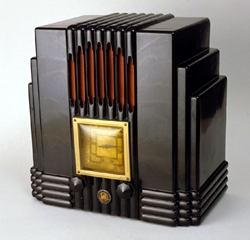
picture in 1946. Shown above is a Fisk Radiola broadcast receiver,
manufactured by AWA in the early 1930's.
An
 independent tribute to Ernest Fisk the
amateur, the enthusiast, is provided by the fact that, in 1921, while
he was hobnobbing with the Australian Prime Minister and making his presence
felt at an Empire level, he was still chairing meetings and 'chewing the
rag' with fellow amateur radio operators as President of the
NSW division of the Wireless Institute of Australia (WIA). Ernest Fisk was
knighted for his services to Australia in 1937. A friend of Fisk's, F. W.
Larkins, once wrote of Fisk "As Marconi discovered wireless, so E. T. Fisk
discovered a continent - a continent without wireless, but a continent where
he was destined to become one of it's greatest wireless pioneers". independent tribute to Ernest Fisk the
amateur, the enthusiast, is provided by the fact that, in 1921, while
he was hobnobbing with the Australian Prime Minister and making his presence
felt at an Empire level, he was still chairing meetings and 'chewing the
rag' with fellow amateur radio operators as President of the
NSW division of the Wireless Institute of Australia (WIA). Ernest Fisk was
knighted for his services to Australia in 1937. A friend of Fisk's, F. W.
Larkins, once wrote of Fisk "As Marconi discovered wireless, so E. T. Fisk
discovered a continent - a continent without wireless, but a continent where
he was destined to become one of it's greatest wireless pioneers".
In 1944 Sir Ernest Fisk resigned his position as
Chairman of AWA, leaving AWA's management reins in the capable hands of his
long-time deputy, Lionel Hooke. He had accepted the position of Managing
Director of Britain's Electrical and Musical Industries (EMI) and, as a
result, re-located back to England. Upon his
retirement from EMI, at age 65, Sir Ernest Fisk returned to Australia to
live, where he remained until his death at age 78, in 1965.
Appendix -
Evolution Of The Radio
Valve In Receiving Systems
-
1875
-
American inventor,
George. R. Carey (born 1851) invented the phototube.
-
1878
-
British chemist and physicist,
Sir William Crookes (17 June 1832 – 4 April 1919) invented the
'Crookes tube', an early version of the cathode-ray tube.
-
1895
-
German physicist,
Wilhelm Roengten
(27 March 1845 – 10 February 1923) invented an early version of the
X-ray tube.
-
1897
-
German inventor and physicist,
Karl Ferdinand Braun
(6 June 1850 – 20 April 1918) invented the
cathode ray
oscilloscope.
-
1904
-
British Electrical engineer and physicist,
John Ambrose Fleming (29 November 1849 - 18 April 1945)
invented the first practical electron tube or valve, called the 'Fleming
Valve'. This electron tube or valve was a two element diode designed to
detect radio signals.
-
1906
-
American
inventor,
Lee de Forest (August 26, 1873 - June 30, 1961) invented
the Audion, later called the triode as it incorporated three elements.
It was an improvement on the 'Fleming Valve' because it was capable of
providing signal amplification.
-
1913
-
American
physicist,
William D. Coolidge (October 23, 1873 - February 3, 1975)
invented the 'Coolidge Tube', the first practical X-ray tube.
-
1920
-
The company RCA
was formed, and amongst other products, marketed a range of triode
vacuum tubes / valves. These tubes / valves were manufactured for RCA by
General Electric at their lamp works in Harrison, New Jersey as well
as by
Westinghouse. The manufacturing/marketing agreement between these
three companies that allowed this lasted until 1930.
-
1921
-
American electrical engineer,
Albert Hull
(19 April 1880 - 22 January 1966) invented the magnetron vacuum tube /
valve. It was used to generate extremely high frequency oscillation in
the microwave region and later went on to be the mainstay of radar
during World War 2.
-
1922
-
American Inventor
Philo T. Farnsworth
(August 19, 1906 - March 11, 1971)
developed the first electron tube scanning system for television.
-
1923
- Russian inventor,
Vladimir K Zworykin
(July 29, 1888 - July 29,1982) invented the iconoscope or the kinescope.
-
1926
-
American electrical engineers
Albert Hull and N. H Williams working for General Electric
co-invented the tetrode vacuum tube.
-
1926
-
Dutch electrical engineers
Gilles Holst
and
Bernhard
D.H. Tellegen
(24 June 1900 - 30 August 1990)
working for the Philips Physics Laboratory, invented the pentode vacuum
tube / valve.
-
1938
-
American physicists and engineers, the brothers
Russell (April 24, 1898 - July 28, 1959) and Sigurd Varian (May 4, 1901
- October 18, 1961)
co-invented the klystron tube / valve. The klystron allowed low noise
amplification of microwave signals.
BIBLIOGRAPHY
“Radio-Craft”
– March 1938 – Hugo Gernsback, Editor.
“200
Metres & Down” – 1936 -
Clinton B. DeSoto.
“Handbook of Technical Instruction for Wireless Telegraphists” –
Third Edition 1925 – J. C. Hawkhead.
“Handbook of Wireless Telegraphy – 1938 – Admiralty.
“Radio Physics Course” – 1930 –Alfred A. Ghirardi.
“QST” magazine – May 1934, December 1940, January 1964 – ARRL.
“CQ” magazine – November 1959 – Cowan Publishing Corporation.
“The Superheterodyne Receiver” – 1941 – Alfred T. Witts.
"HRSA Newsletter July 1985" - R. Kelly
“When I Think Back" - Neville Williams.
|
